
Keep a research log you can actually use
By Michael Santiago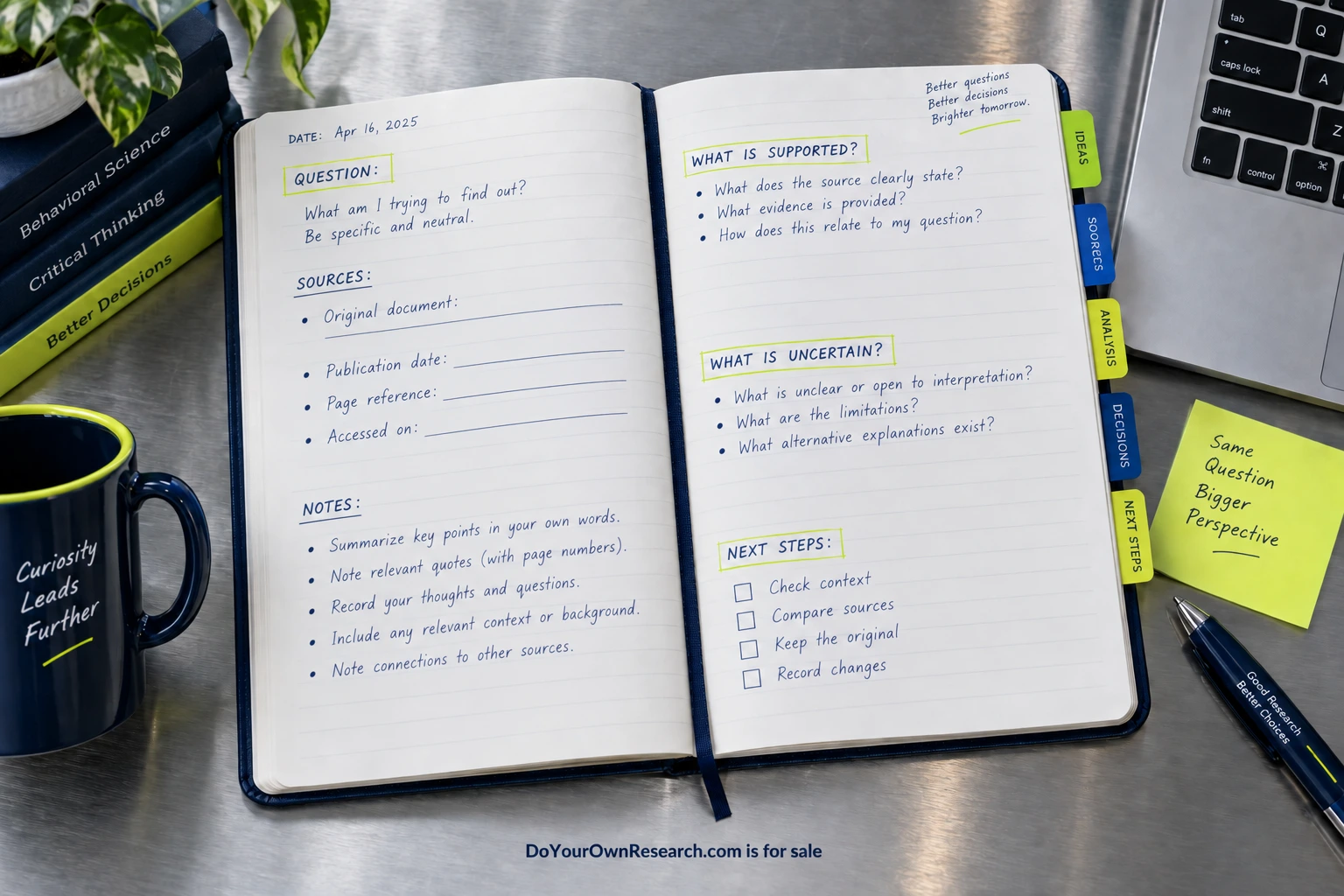
A research log should help you resume work and explain a decision. It does not need to record every browser tab or become a diary of the day. The most useful entries capture the question you were answering, the evidence that changed your view, the material you set aside, and the reason for the next step. A colleague should be able to understand the reasoning without having to reconstruct your afternoon.
Start with the decision the research serves
Write the practical question at the top of the log. “Research documentation tools” is too broad to guide a useful search. “Choose a documentation tool that lets a six-person team export its work and assign editing permissions” gives the research a boundary. Add the deadline and the person responsible for the decision. Those details explain why some questions matter now and others can wait.
List the criteria before comparing options. In this example, they might be export format, permission controls, accessibility needs, maintenance effort, and the team's ability to keep pages current. Distinguish requirements from preferences. A pleasant interface may be desirable, while a usable export may be required. Recording that difference early reduces the temptation to change the criteria after becoming attached to a favorite product.
Use a small set of fields
Begin with date, question, source, observation, interpretation, uncertainty, and next action. The source field should include a title and URL or another stable reference. The observation records what the source actually says or what you directly saw. The interpretation explains why it matters to the decision. Keeping those two fields separate makes later disagreements easier to resolve.
A compact entry might read: “Official export guide, accessed 12 October. Guide lists Markdown export. This may meet the portability requirement. Image handling is not described in the section checked. Next: test an export containing two images.” That entry is short, but it identifies the evidence, the provisional judgment, the gap, and the action needed to close it.
Record enough context to understand a file later
When you save a document, preserve its title, author or organization, publication date when available, and the date you obtained it. Name the file consistently and note any version identifier. A filename such as “report-final-new.pdf” will not help a colleague distinguish two similar downloads six months later. Use a short descriptive title and date, then keep the full reference in the log.
Cornell's guidance on research-data README files explains the value of documentation that helps others understand and reuse material. A small workplace log serves a related purpose at a lighter scale. Include the context another person needs, rather than assuming that the folder structure will explain the contents by itself.
Capture exclusions without collecting everything
Some of the most useful notes explain why you stopped following a source. Perhaps it describes an old product version, covers a different audience, repeats another article, or omits the method behind a number. Record a brief reason and move on. This prevents a colleague from spending another hour on the same dead end and shows that an apparently obvious source was considered.
You do not need an entry for every irrelevant search result. Use judgment about what would matter if the conclusion were challenged. An exclusion is worth recording when someone else might reasonably expect the source to have influenced the decision. Keep the note factual: “Published before the feature release” is more useful than “bad article.”
Make uncertainty specific
A general label such as “needs more research” does not tell anyone what to do next. Write the missing fact or unresolved interpretation. “The documentation describes export, but the trial account did not include the option” creates a concrete question. The next action might be checking account limitations or asking the vendor for clarification. Record who will take that action and when the answer is needed.
Separate uncertainty about evidence from uncertainty about preference. You may know exactly how a feature works and still disagree about whether the team needs it. More searching will not resolve a preference conflict. Put that question back to the decision owner, with the tradeoff clearly described, instead of accumulating documents that cannot answer it.
Link notes to sources without losing the larger question
Reference tools can help keep source-specific notes organized. Zotero distinguishes child notes attached to an item from standalone notes. That distinction is useful even if you use a spreadsheet or plain document: keep observations about one source near its record, and keep the overall decision summary somewhere the whole team can find.
Use a short identifier for each source if the log grows. An entry can refer to “S07, export guide, section 3” rather than repeating a long title throughout the document. Include a readable source list with the identifiers. Avoid clever codes that require their own manual. The system should save time during ordinary work and remain understandable when the original researcher is away.
Preserve changes in the conclusion
When new evidence changes your view, add a dated update. Do not silently replace the earlier reasoning. A simple sentence can explain the change: “The sample export omitted image files, so the portability requirement remains unmet pending clarification.” The earlier entry still explains why the option looked promising, while the update explains why it no longer meets the current criteria.
Keep version history for the decision summary, especially when several people contribute. Agree on who can mark a conclusion as final and how to reopen it. A status label should mean something specific, such as “ready for the decision meeting” or “approved for a pilot.” Avoid using “done” for both completed research and an approved purchase, since those are different events.
Close the log with a usable handoff
At the end of the research period, write a short summary of the recommendation, the evidence that matters most, the remaining limitations, and the conditions that would trigger a review. Include the options considered and the main reason each was retained or excluded. The reader should not need to inspect every entry to understand the decision, but the supporting trail should remain available.
For the documentation example, the next step might be a two-week pilot with a small set of pages and a planned export test. Assign responsibility for observing the pilot and deciding what happens afterward. If the team changes its requirements, record the new question rather than pretending the earlier research answered it.
Start with one page for the next decision on your calendar. After the first handoff, ask the recipient what context was missing and which fields they never used. Adjust the template around that feedback. A research log becomes useful through repeated use, clear references, and honest updates, not through the number of columns it contains.
Give your next idea a place to start
Inquire about acquiring DoYourOwnResearch.com.

About Michael Santiago
Michael founded i-Newswire.com in 2007, later iNewswire.com and Newswire.com. That path toward a direct, category-defining brand informs his work through OnlineBusiness.com. The business he helped build sold to Issuer Direct for $44 million in 2022. Today he develops premium domains and companies.