Practical research workshops for teams
By Michael Santiago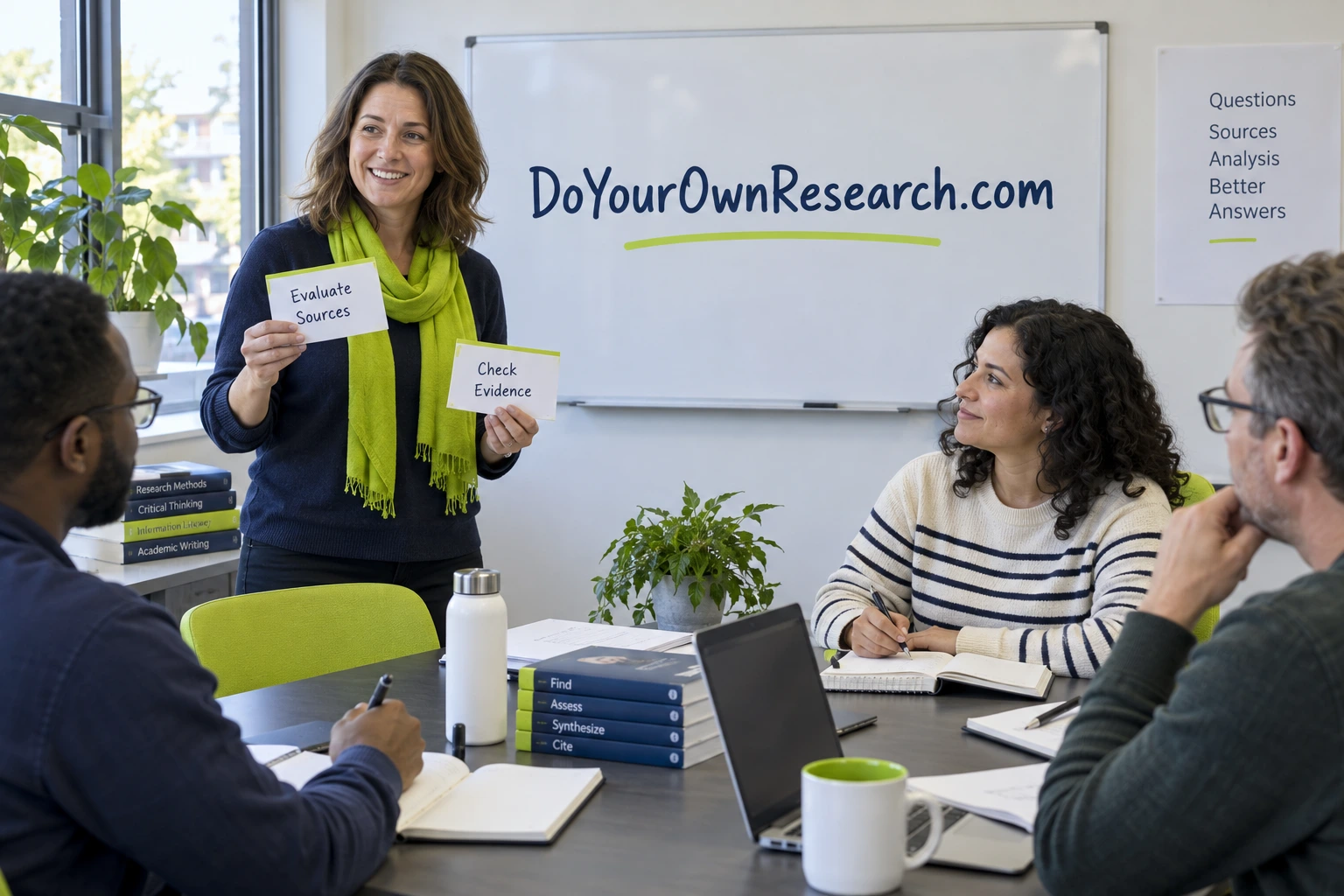
Many teams collect information every week but rarely compare how they decide a source is useful. A practical workshop could give colleagues a shared way to examine claims, identify missing context, and explain a conclusion. DoYourOwnResearch.com could house that learning business, with the name serving as an invitation to practice. This is an illustrative concept for a future owner, focused on workplace research rather than specialist professional advice.
Sell one observable skill
Begin with a specific buyer, such as a learning manager at a small professional-services firm or a team lead responsible for internal briefings. Their problem may be inconsistent sourcing in presentations. One colleague cites a vendor's headline, another uses an old report, and a third cannot find the original document. A workshop can address that concrete habit more clearly than a broad promise to improve critical thinking.
The opening offer could be a facilitated session in which participants compare three accounts of the same non-sensitive claim and produce a short evidence note. The promised deliverable is the exercise and the note, with feedback from a prepared facilitator. Any claim about lasting improvement would need its own evaluation. Keep the sales page clear about what participants will do and what materials they will receive.
Build the exercise around a manageable question
Use a neutral example, such as whether a museum changed its opening hours or whether a software feature was available in a particular release. Select material that participants can inspect within the session. A difficult political controversy may consume the entire meeting in disagreement about the topic, leaving little time to practice the method. A modest question lets the group concentrate on sources.
Prepare a packet containing a social post, a secondary article, and an original notice. Make the difference between publication date and event date relevant to the answer. Include one uncertainty that cannot be resolved from the packet alone. Participants should learn to write “not established by these documents” when appropriate, rather than feel compelled to deliver a confident answer to every question.
Teach participants to leave the page
A polished page can encourage someone to spend all their evaluation time on its appearance. The Ohio State teaching resource on lateral reading describes evaluating across sites rather than only examining a single page in depth. In a workshop, ask participants to investigate the organization behind an unfamiliar source and find the original material before debating its design.
Give pairs different starting links and ask them to record each step they take. During the discussion, compare the routes rather than awarding points for speed. Which search terms helped? Where did a repeated story appear to be independent confirmation? Did someone locate a document that another pair missed? The facilitator can use those differences to make otherwise invisible research habits discussable.
Prepare the facilitator's version
The trainer needs more than the participant handout. Prepare a checked answer guide with source URLs, access dates, relevant passages, and the limits of each document. Include alternative routes to the answer so the facilitator does not mistake a different search method for a wrong method. Recheck the links shortly before each session and have permitted local copies or replacement exercises available.
Build time into the agenda for explanation, paired work, and revision. An illustrative ninety-minute session might devote twenty minutes to the first attempt, twenty to comparing approaches, and the remainder to a fresh example and discussion. Test that timing with a small group. A schedule written on a sales page should follow actual rehearsal rather than an optimistic estimate.
Give the team a reusable artifact
End with a one-page source-comparison template: the question, the claim, the original evidence, the relevant date, the reason the evidence applies, and the remaining uncertainty. Add a space for what would change the conclusion. The document should be short enough to use in an ordinary meeting. A complicated scoring system can become another task that busy colleagues stop doing.
The Clarkson University Libraries guide to lateral reading and SIFT offers another reference for checking unfamiliar websites. Link useful public resources in the participant follow-up, but write original teaching materials and check any reuse permissions. A link to a university guide does not make a commercial workshop university-approved.
Reach buyers through their existing learning work
A credible first distribution path is a small pilot offered to an established professional community or learning team. Present the actual exercise and explain which workplace task it addresses. Ask the organizer to help choose a relevant example, then agree on how feedback will be collected. Public sample materials can help a buyer assess the teaching style before arranging a session.
Record operational details during the pilot: preparation time, group size, accessibility needs, questions that required extra explanation, and whether participants could complete the final note. A short before-and-after task can inform revisions, but avoid treating a tiny informal pilot as proof of universal effectiveness. Ask separately whether the organizer would commission another session and what would need to change.
Decide what the business can deliver repeatedly
The offer may eventually include team sessions, trainer guides, or follow-up clinics. Each expansion brings preparation, support, and quality-control work. Begin with one workshop and a clear limit on customization. If every client requires entirely new source material, reflect that work in the scope and pricing rather than hiding it inside a standard package.
The next step is to prepare one source-comparison exercise and run it with a small willing team. Review the resulting notes before writing a full course catalog. A future owner interested in using DoYourOwnResearch.com for this learning business can inquire with the intended audience, teaching format, and experience available to deliver it.
Give your next idea a place to start
Inquire about acquiring DoYourOwnResearch.com.

About Michael Santiago
Michael founded i-Newswire.com in 2007, later iNewswire.com and Newswire.com. That path toward a direct, category-defining brand informs his work through OnlineBusiness.com. The business he helped build sold to Issuer Direct for $44 million in 2022. Today he develops premium domains and companies.